
A Better Way to Learn and Grow
For a long time, I lived by an unwritten rule – if you aren’t focused intensely, you aren’t really learning.
Growing up, the message I heard was always to study harder. In college and later as an engineer, that turned into a lifestyle habit. I cut my breaks down to nothing, pushed through mental fatigue, and rarely slept more than six hours a night. I assumed the brain was simply a muscle you had to keep pushing until things completed.
Of course, when looking back, some of my best ideas and solutions only popped up while I was taking a walk or doing something unrelated. But back then, I brushed those off as lucky accidents. Work deadlines were always there, and the pressure always pulled me right back into white-knuckling my way through every problem.
Recently, learning the course “Learning How to Learn” framework gave me the science behind what was actually happening [Oakley & Sejnowski, 2014]. I have more clear insights on how the brain alternates modes, how we get stuck in habit loops, and how stories help us see differently. It not only improved how I study, but also shifted how I coach families and individuals.
1. Focused vs. Diffuse Thinking – Your Brain Needs Both Gears
The Focused Mode is your mental narrow focus. It kicks in when you sit down with concentrated attention, such as analyzing details, solving an equation, or editing a document. It operates through familiar, tightly connected neural networks in your prefrontal cortex to work through problems step by step.
The Diffuse Mode is your mental broad view. When you step away from the desk, go for a walk, or let your mind wander, your brain does not shut off. It switches to a resting state network that looks at the big picture [Raichle, 2015]. It links distant ideas together in ways your narrow spotlight cannot reach.
When I used to push through hours of continuous mental strain on six hours of sleep, I was spinning my wheels. The brain physically needs downtime and sleep to organize, clean out waste, and solidify what it has just learned into long-term memory [Stickgold, 2005].
How do I apply this now?
I no longer view breaks as lost productivity. After 30 to 40 minutes of deep, focused effort, I step away for 10 minutes without phones and computers, just movement, water, snacks or looking outside. That brief pause gives the diffuse mode room to process what I just absorbed so I can return with complete mental clarity.
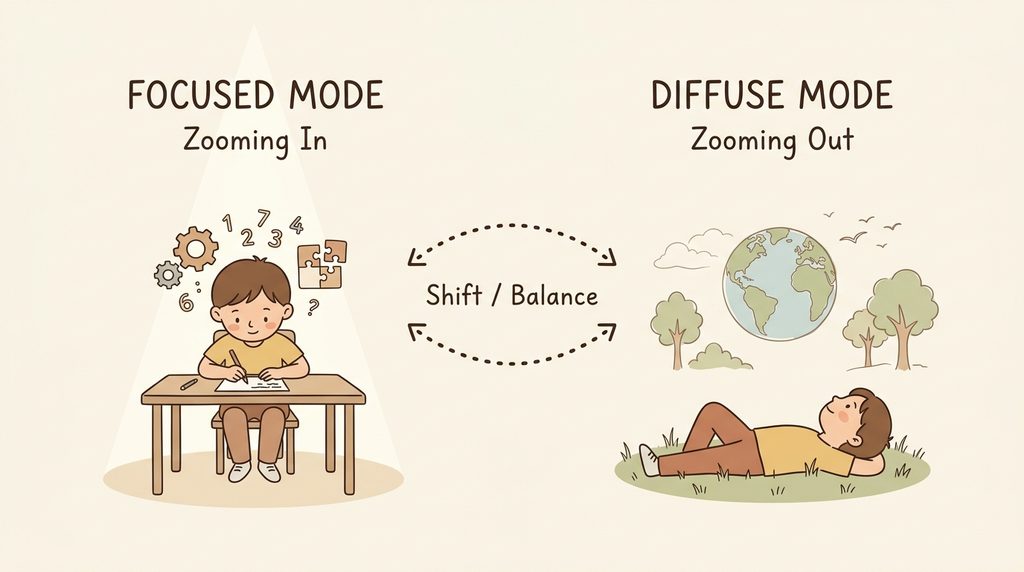
2. The Danger of the Familiar Cycle – The Einstellung Effect
Have you ever hit a trap on a problem, tried harder and harder using the exact same strategy, and only ended up more frustrated?
Cognitive scientists call this the Einstellung effect [Luchins, 1942]. It describes what happens when an initial, familiar idea or habit blocks you from seeing a simpler, far better solution.
Because the human brain naturally conserves energy, its first impulse is always to take the path of least resistance. When an obstacle appears, the brain follows the neural tracks that have been traveled a thousand times before. I often found myself trying to force a new problem into an old technical framework, even when the situation takes a fresh perspective.
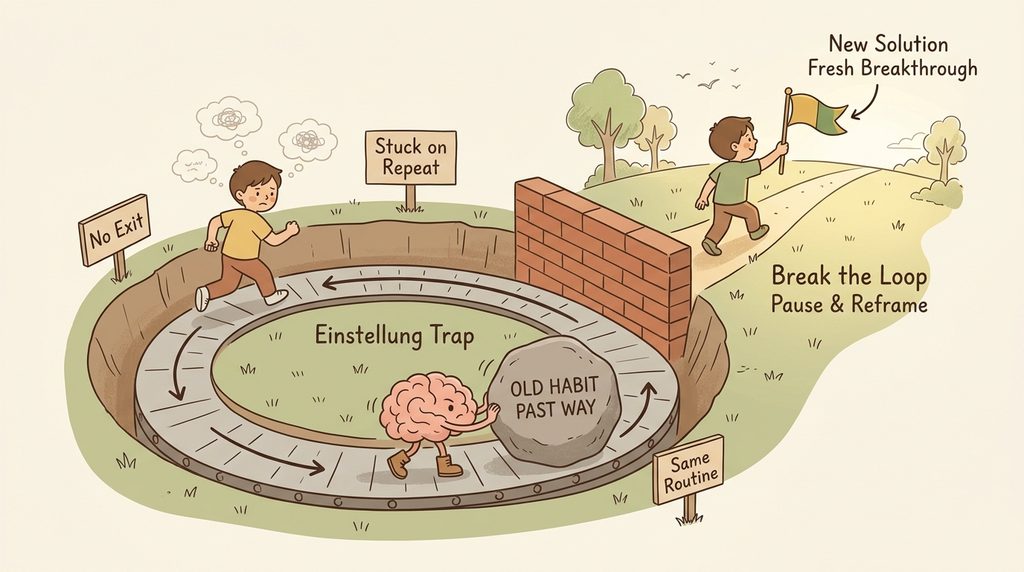
In daily life and relationships, this happens constantly.
- A parent continues defaulting to lecturing a teenager because directive advice was effective during childhood. As the child matures, this automatic pattern fails to adapt to their need for autonomy, creating immediate resistance and conflict.
- A manager attempts to resolve interpersonal team friction solely through logical analysis, metrics, and structured procedures. By relying strictly on analytical tools, they overlook the underlying emotional concerns and interpersonal trust required for effective collaboration.
When you feel persistent mental friction, pushing harder in focused mode usually just digs the hole deeper. The most productive move is to recognize the trap, stop, and step away to disrupt the cycle.
3. Using Metaphors and Stories to See a Way Out
How do you pull your brain out of an Einstellung trap? One of the most effective tools is metaphor.
Metaphors and analogies are far more than creative languages. Cognitively, they serve as bridges [Gentner, 1983]. They shape how we perceive, reason through, and break free from rigid mental frameworks [Lakoff & Johnson, 1980]. When you compare an unfamiliar or frustrating situation to a familiar story, your brain naturally steps out of its narrow track and searches across wider memory networks to find fresh connections.
A Coaching Analogy – The Lost Captain
When I first transitioned from engineering into life coaching, my old habits surfaced immediately. A client would share a challenge, and within minutes I was trying to “debug” their life: diagnosing the issue and handing them a tidy three-step action plan.
It did not work. Giving quick advice rarely creates lasting change. Real growth happens when people discover new perspectives for themselves.

To help myself step out of that problem solving habit, I started using this mental picture:
“Imagine a captain standing at the helm of a modern ship, drifting through heavy fog. The control room is equipped with advanced radar, sonar, and navigational charts. Yet the captain feels completely lost, gripping the wheel tightly and staring blindly into the dark. The ship does not need external tools brought in. The instruments are already right there on board. The captain simply needs help turning them on and learning how to read the gauges.”
That image changed how I coach. My role is not to steer the ship or dictate the destination. It is to sit beside the captain and ask the right questions:
- Focused questions: Clarify the present facts. “What specific triggers or observations are you reacting to right now?”
- Diffuse questions: Use stories or shift viewpoints to build new insight. “What assumption are you making here that might not be entirely true?”
- Big-picture questions: “If you step back and look at the bigger picture, how does that change your view of the situation?” “If you looked back at this situation five years from now, how would you want your response to look?”
By moving between focused clarity and broad, reflective storytelling, coaching stops being a collection of quick tips and becomes a way to help people build lasting mental flexibility.
4. Check Your Understanding Now
Research shows that retrieving an idea from your own memory builds far stronger neural connections than simply re-reading it [Karpicke & Blunt, 2011]. Pause for a moment and consider these two questions:
Reflection 1: When you find yourself stuck in a frustrating rut, what is your brain’s default instinct, and what should you do instead?
Take a second to answer in your mind…
Takeaway: The brain naturally follows the path of least resistance, stubbornly reusing familiar patterns (Einstellung). Stepping away into diffuse mode disrupts that loop and allows new connections to form.
Reflection 2: Why does framing a stubborn dilemma as a story or metaphor help break a mental block?
Take a second to answer in your mind…
Takeaway: Metaphors bridge what you already understand with what is currently unfamiliar, prompting your brain to make broad, cross-domain connections.
5. A Balanced Daily Rhythm to Take Forward
Here is a straightforward structure to put these principles into practice:
- Focused Work Blocks (30–35 minutes): Dedicate this window to a single task with zero notifications. Stop when your timer ends.
- Diffuse Recovery (5–10 minutes): Step away from screens. Walk around, stretch, drink water, or look into the distance to let your subconscious consolidate your thoughts.
- Evening Memory Retrieval (5 minutes): Before ending your day, close your notes and write down two key ideas you learned from memory.
- Protected Sleep (7–8 hours): Treat sleep as an active part of your learning. During rest, your brain cleans away waste products and solidifies the neural connections you built during the day.
References and Reading Notes
- Oakley, B., & Sejnowski, T. J. (2014). Learning How to Learn: Powerful mental tools to help you master tough subjects. Coursera / UC San Diego.
- Raichle, M. E. (2015). The brain’s default mode network. Annual Review of Neuroscience, 38, 433–447.
- Stickgold, R. (2005). Sleep-dependent memory consolidation. Nature, 437(7063), 1272–1278.
- Luchins, A. S. (1942). Mechanization in problem solving: The effect of Einstellung. Psychological Monographs, 54(6), i–95.
- Gentner, D. (1983). Structure-mapping: A theoretical framework for analogy. Cognitive Science, 7(2), 155–170.
- Lakoff, G., & Johnson, M. (1980). Metaphors We Live By. University of Chicago Press.
- Karpicke, J. D., & Blunt, J. R. (2011). Retrieval practice produces more learning than elaborative studying with concept mapping. Science, 331(6018), 772–775.